
Daily habits
6 min readBuild a daily Qur’an routine
Build a daily Qur’an routine around work and family. Find a regular moment, keep your passage ready and make room for smaller practice on busy days.

In this guide
You want the Qur’an to have a place in your day. Then work runs late, the children need something, or the quiet moment you were waiting for never arrives. You may reach the evening wishing you had opened your mushaf sooner.
Try beginning with a moment you can usually use and a passage you know how to practise. A routine can grow around your ordinary life, with room to adjust when that life changes.
Remember what you’re making time for
Reading the Qur’an gives us time with Allah’s words. Alongside improving recitation or memorisation, we can listen to their guidance and remember the One we worship. Allah says:
أَلَا بِذِكْرِ اللَّهِ تَطْمَئِنُّ الْقُلُوبُ
“Surely in the remembrance of Allah do hearts find comfort.”
Qur’an 13:28, excerpt. Translation: Dr. Mustafa Khattab, The Clear Quran.
Keep that purpose in mind as you plan. You may feel settled during some sittings and distracted during others. You can still return, ask Allah for help and give the passage your attention. The routine needn’t depend on feeling inspired first.
Find a moment that works at home
A quiet spell after a prayer suits some people. Others read after breakfast or once the children are in bed. Think about the time you usually have, rather than the time someone else’s routine recommends.
If you work changing shifts, a familiar part of the day may be a better cue than a clock time. You might read after your first meal at home. If the school run or dinner repeatedly interrupts your chosen moment, move it.
You don’t have to settle this permanently. Try a time during an ordinary week and see how it goes.
Have the passage ready
When you finally sit down, it helps to know where to begin. Keep your teacher’s assignment easy to find, with any note about a correction beside it. If you’re reading independently, choose a familiar passage beforehand.
Be clear about the task. Are you practising a sound, learning a new portion or revisiting earlier verses? If the assignment is unclear, ask before spending the week repeating something you don’t understand.
A reliable translation can also give you a way to revisit the meaning of what you’re reading. Leave space for questions to bring to your teacher. For hifz, make sure older passages remain in view; our revision guide can help you plan that.
Keep the setup simple
Keep your mushaf, lesson notes and anything else you need together. A mushaf is a written copy of the Qur’an. If you use recommended audio, have the right passage ready rather than searching through recordings during practice.
A comfortable place where you can pay attention may be enough. You don’t need to wait for a special room. Deal with small obstacles, such as misplaced headphones or a hard-to-find assignment, when you have a spare moment.
Give small, regular practice a place
The Prophet ﷺ said, as part of his guidance about moderation and regular deeds:
وَأَنَّ أَحَبَّ الأَعْمَالِ أَدْوَمُهَا إِلَى اللَّهِ، وَإِنْ قَلَّ
Meaning: “And the deeds most loved by Allah are those done regularly, even if small.”
Sahih al-Bukhari 6464, excerpt. English rendering of the meaning.
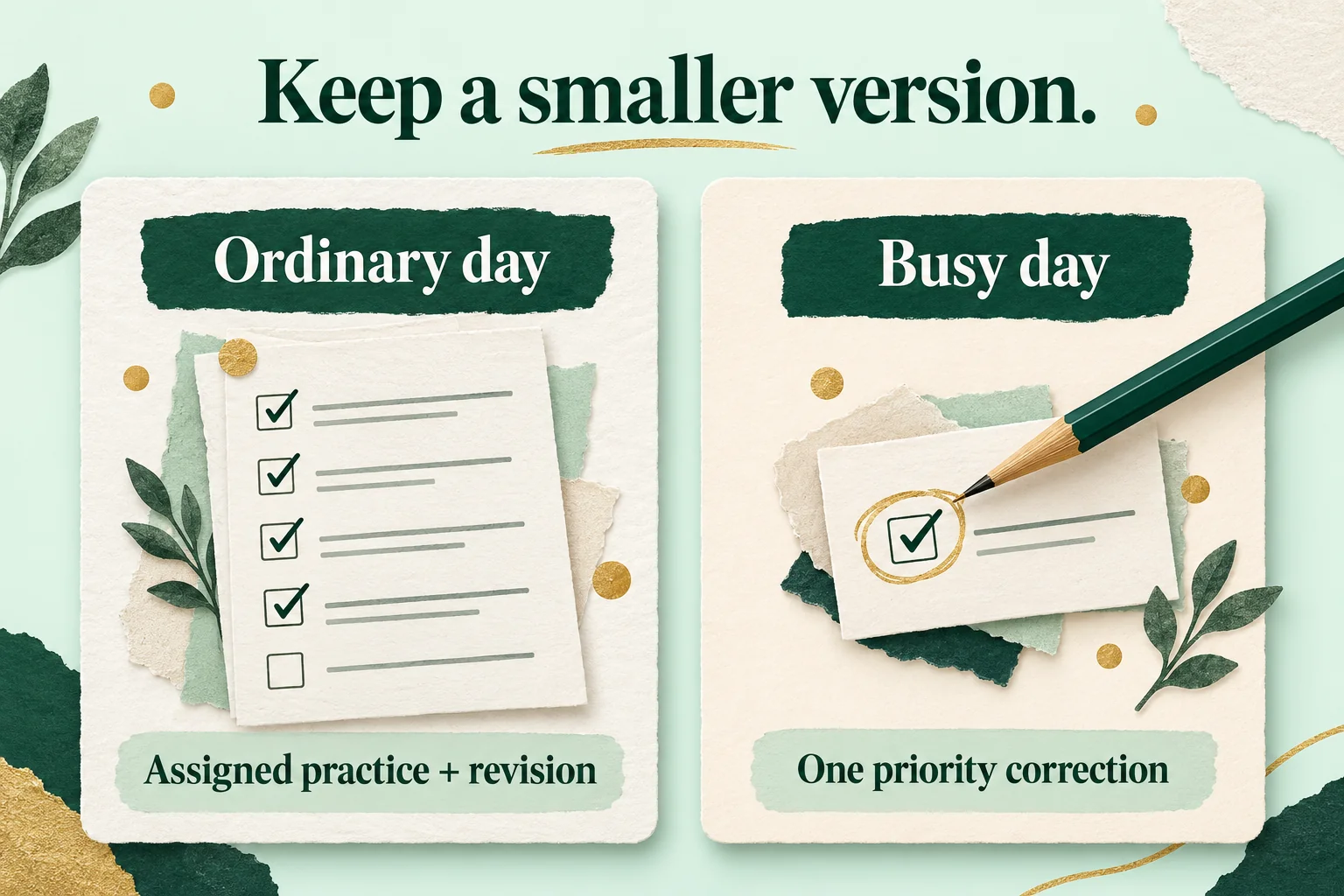
That encouragement can help when you are tempted to plan more than an ordinary week allows. Ask your teacher which shorter task to focus on when time is limited. You might carefully revisit a correction or recite a smaller portion.
If the smaller amount is what you can manage most days, let them know. Your usual assignment may need changing so there is room for accurate reading and revision. This hadith encourages constancy; it doesn’t prescribe a particular number of minutes or verses.
What if you miss a day?
Come back at the next opportunity. You don’t need to wait for Monday or a week with no interruptions.
If you have fallen behind on an assignment, ask your teacher where to restart. Doubling the work automatically can leave you with the same difficulty tomorrow. A passage needing attention is something to discuss and practise, rather than a reason to avoid your next lesson.
When the same problem keeps returning, look at it gently and honestly. Does the time clash with a responsibility? Are you putting off a passage because you don’t know how to work on it? Change the time or ask for help with the part that has become difficult.
Help the routine grow with your family
For a child, choose a moment when they’ve had a chance to eat or rest. Tell them which passage you’ll practise and when you’ll finish. They can also see you making time for your own reading, even if you are learning different things.
If home practice regularly becomes upsetting, speak with the teacher. Our guide to helping your child practise without pressure gives more support for those moments.
After a week, notice what has helped. You may need no tracker beyond a short note about a word to have checked. Keep what works and adjust what gets in the way.
Begin with your next available moment
Choose when you can sit down next and have the passage ready. Make du‘a, asking Allah to help you learn and benefit from His words, then begin with the work in front of you.
If you’d like guidance with that practice, see how learning at the academy works.
A few questions you might still have
Is there a best time to practise?
Choose a time when you can usually give your attention. A morning may be quiet in one home and busy in another. If your chosen time repeatedly clashes with responsibilities, try another.
How long should I practise?
Discuss your assignment and available time with your teacher. Leave room to correct mistakes and revisit earlier work. If you often run out of time, ask for help adjusting the amount.
Can listening take the place of reciting?
Listening helps you hear a model. You still need to practise your own recitation and have uncertain sounds checked. Follow your teacher’s guidance about using audio between lessons.