Revision
6 min readA Qur’an revision schedule that fits
Build a Qur’an revision schedule for recent and older memorisation. Adapt an example week with your teacher and give difficult passages the attention they need.

In this guide
You knew the passage yesterday. Today you reach the same join and lose your place. That can be frustrating, especially when you want to move on to new verses. Bring that part back into your practice and let your teacher hear where you get stuck.
Muraja’ah means revision. It gives the Qur’an you’ve learned a continuing place in your day, including the passages that have become less familiar.
Revision is part of caring for what you’ve learned
The Prophet ﷺ said:
تَعَاهَدُوا الْقُرْآنَ فَوَالَّذِي نَفْسِي بِيَدِهِ لَهُوَ أَشَدُّ تَفَصِّيًا مِنَ الإِبِلِ فِي عُقُلِهَا
Meaning: “Keep attending to the Qur’an. By the One in Whose hand is my soul, it escapes more readily than camels from their restraints.”
Sahih al-Bukhari 5033. English rendering of the meaning.
The reminder makes continued attention part of our learning. Even a passage that once felt settled needs returning to. A slipping join tells you where to give some care; it doesn’t tell you the state of your faith.
You can ask Allah to help you retain and benefit from His words, then make a practical plan for revisiting them.
Begin with the passages you know
Write down the surahs or portions you’ve memorised, including where each starts and ends. If you’ve learned scattered passages, list them separately. A simple note is enough.
Recite some of that work and notice where you need help. Which portions come back comfortably? Where do you need a prompt? What would you like your teacher to check?
An older passage may be stronger than a recent one. Let your recitation guide the attention it receives, rather than assuming the newest work always needs the most time.
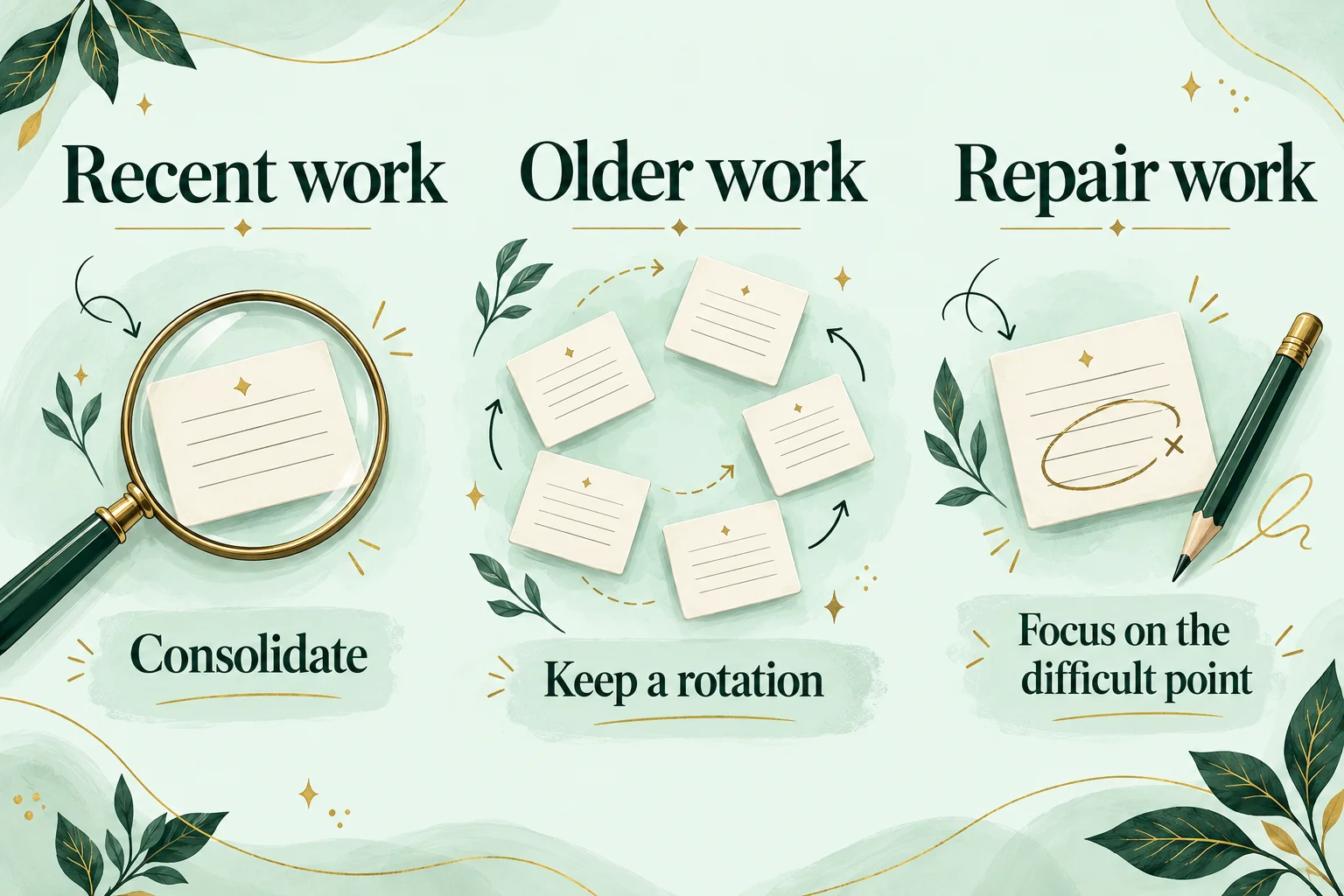
Give recent and older work a place
Ask your teacher how often to revisit the current assignment and when they will hear it again. Keep it close enough that corrections remain familiar.
Divide older memorisation into portions you can manage during a normal sitting. Make room for each, so you return to more than your favourite surahs.
When a word or transition keeps slipping, practise that part carefully and then recite it in the surrounding passage. If you’re unsure about the correction, ask. Your plan will look different when you know a few short surahs than when you revise several ajza’, the plural of juz, a division of the Qur’an.
Leave time to recite carefully
In His instruction to the Prophet ﷺ about night prayer, Allah says:
وَرَتِّلِ الْقُرْآنَ تَرْتِيلًا
“and recite the Quran ˹properly˺ in a measured way.”
Qur’an 73:4, excerpt. Translation: Dr. Mustafa Khattab, The Clear Quran.
Keep that care for recitation in view when choosing your workload. If getting through the assigned amount leaves you rushing the words or skipping corrections, discuss a smaller portion with your teacher.
You can revisit the meaning of familiar ayat too, using a reliable translation or an explanation your teacher recommends. The schedule should make room for attention to Allah’s words, rather than leaving you thinking only about which page comes next.
What could a week look like?
Suppose you’ve divided your older memorisation into four manageable portions. You could move through them while keeping your current assignment in the week. Here is an example to discuss with your teacher:
| Day | What you could revisit |
|---|---|
| Monday | Your current passage and older portion A |
| Tuesday | Your current passage and portion B, with time for a difficult join |
| Wednesday | The recent work your teacher assigned and portion C |
| Thursday | Recent work and portion D; bring uncertain parts to your lesson |
| Friday | Portion A again and the correction from your lesson |
| Saturday | Portion B and anything from the week that still needs attention |
| Sunday | The portion agreed with your teacher and a look at next week’s plan |
Replace the letters with your own surahs and ayah ranges. You may need smaller portions, a different rotation or more time on one passage. Make sure all your older work has a place to return, including C and D in the next part of the rotation.
This example is not a religiously prescribed timetable or a tested interval for every learner. Your teacher can help you adapt it as the amount you know grows. Reserve revision time before deciding how much new memorisation fits.
Bring the difficult part to your next lesson
“I need a prompt before the final ayah” gives your teacher something specific to hear. After the lesson, keep their advice beside that note.
You don’t need to record every repetition. A brief reminder of the uncertain part can help you return to practising. If several passages begin needing more support, discuss the overall workload before adding more new material.
What if you miss a day?
Return with an amount you can manage. You don’t have to double everything tomorrow. If a missed passage would otherwise disappear from the week, find another place for it and ask your teacher what to prioritise.
When the same slot keeps getting missed, look at the reason. It may clash with a responsibility, or the portion may take longer than expected. Keep what works and adjust the part that doesn’t. Our daily routine guide offers help finding that moment.
Let the plan change as your learning grows
More memorisation brings more to revise. Raise the workload with your teacher when earlier passages start needing extra attention. They may suggest smaller new portions or a period focused on revision.
General research supports recall practice spread over time, but it doesn’t validate the example timetable above. Your own recitation and the teacher’s feedback remain important when deciding what to revisit.
If you’re just beginning, read our guide to memorising the Qur’an. You can also see how the academy connects lessons and practice.
Questions about revision
How much should I revise each day?
Ask your teacher to hear some of your memorisation and help choose the amount. Leave time for correction. Someone else’s page target may not suit what you know or the time you have.
Should I revise before learning new verses?
Reserve time for revision before deciding how much new work fits. Follow your teacher’s advice about the order. If earlier passages need considerable attention, discuss reducing new memorisation for a while.
Do I need an app?
A notebook may be enough to find the passage and remember the teacher’s guidance. An app can help with reminders, but it can’t establish that your recitation was accurate or replace someone listening.