Memorization
11 min readHow to memorise one page of the Qur’an a day
Imagine reciting the Qur’an from memory. Here’s how to build towards a page a day, with manageable practice and enough room for revision.
In this guide
Bismillah.
One page a day. If you’ve been thinking about memorising the Qur’an, you’ve probably tried doing the maths.
With a 604-page mushaf, that comes to roughly a year and eight months. You start thinking about what that could mean: standing in salah and reciting surahs you used to listen to, without needing to open the page.
Then you look at your week.
There’s work, there are children, and there are evenings when you’re tired before you’ve even sat down. You want to give the Qur’an more time, but you’re wondering whether you can keep up with a full page every day.
It’s a fair question. A page can take more work than you expect, especially when you’re learning unfamiliar words or trying to remember yesterday’s lesson. And that year-and-eight-month calculation leaves out revision days, difficult passages and the interruptions that happen in an ordinary life.
Still, a page a day is something you can work towards, insha’Allah. You can begin with a smaller portion, find a time you can protect, and build up with your teacher’s help.
Let’s go through what that could look like.
Before you choose your daily amount
It’s easy to become attached to a target. You’ve decided on a page a day, so anything less can feel disappointing.
But before settling on that amount, have someone qualified listen to your reading. If you’re still struggling to pronounce the words, learning a whole page from memory may leave you repeating mistakes without realising it.
You may need to begin with a few ayat while you improve your reading. Or perhaps you read comfortably, but half a page is what you can manage alongside revision. Your teacher can help you work that out.
There’s something worth reflecting on in Isra Migdad’s account of memorising the Qur’an. She describes leaving an intensive memorisation camp because she wanted more time to investigate words and verses she didn’t understand. She later completed her memorisation while balancing work and study.
Your circumstances may be different, but her story raises a useful question: does the pace you’ve chosen leave you enough time to give the verses proper attention?
You want to be able to recite what you’ve learned when you return to it tomorrow. Keep that in mind when choosing your assignment.
Sit down with the same mushaf
Once you have your passage, try to use the same mushaf for your regular practice. Becoming familiar with the layout can help you recognise where an ayah begins and where it sits on the page.
For this example, we’ll use a fifteen-line page. By “one page”, we mean one side, rather than a two-page spread.
Before trying to memorise it, read it aloud. Listen to a recitation your teacher recommends and follow the words carefully. If a word is unfamiliar, stop and check it.
This preparation deserves time. When you begin repeating the passage, you want to be practising the correct reading.
Read a reliable translation too. You may notice that several ayat belong together, or understand why the passage moves from one subject to another. Keep a note of anything you’d like your teacher to explain.
Allah says:
وَرَتِّلِ الْقُرْآنَ تَرْتِيلًا
“and recite the Quran ˹properly˺ in a measured way.”
Qur’an 73:4, excerpt. Translation: Dr. Mustafa Khattab, The Clear Quran.
The verse addresses the Prophet ﷺ in the context of night prayer. As you prepare your lesson, take care with the words and give yourself time to read them properly.
Start with the first part of the page
Looking at fifteen lines at once can feel overwhelming. So, for the moment, give your attention to the first part.
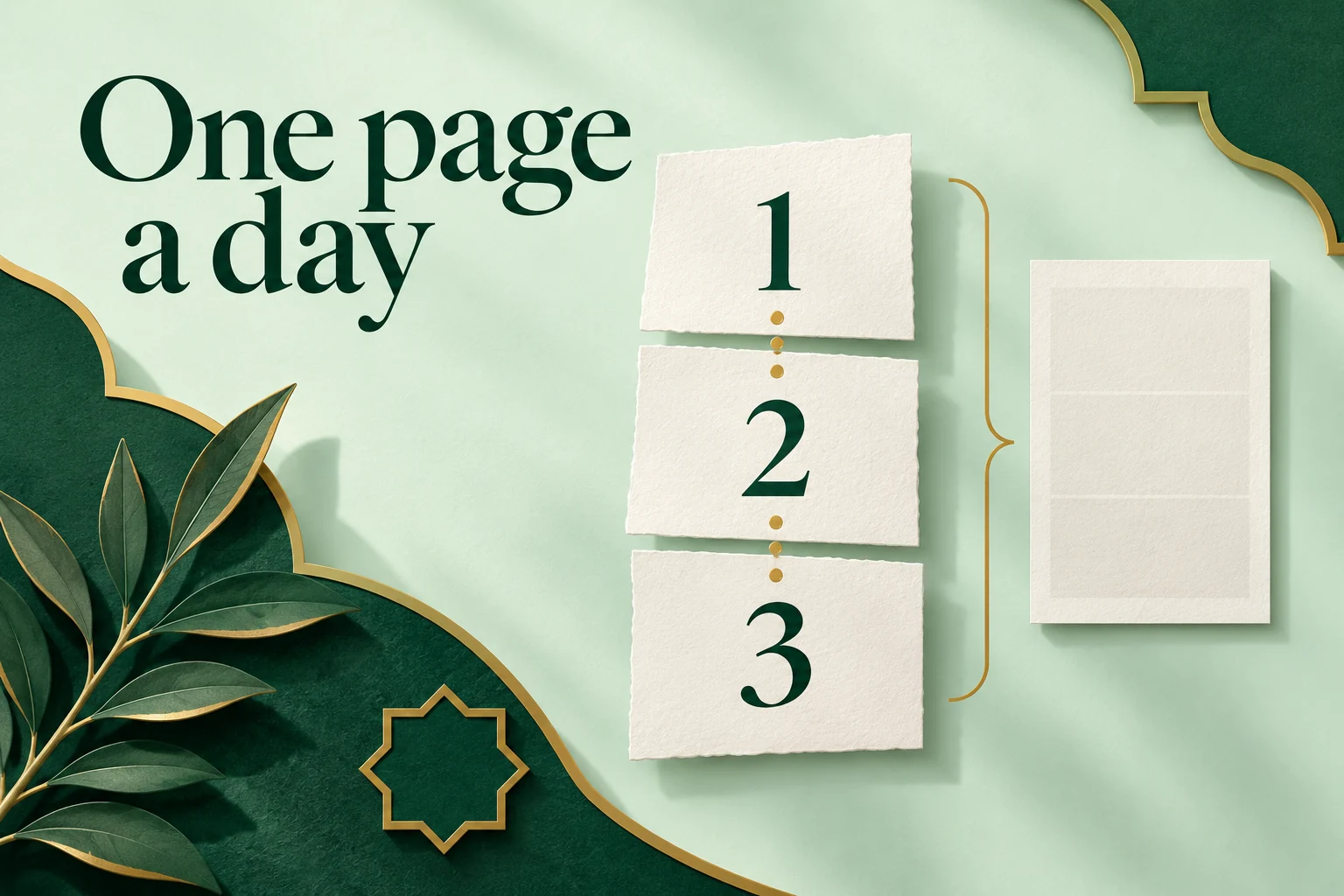
Dividing a page into roughly three sections can make it easier to organise your practice. On a fifteen-line page, you might begin with around five lines.
The stopping point matters more than making the sections equal, though. Some passages will divide naturally into thirds. Others won’t. Ask your teacher where to stop if you’re unsure, especially when an ayah continues beyond the point you had in mind.
Qāri’ Mubashir’s guide to memorising a page describes several ways to divide it, including thirds, halves and smaller groups. You can adjust the portions to suit the passage and your reading.
Now begin with the first ayah, or a shorter portion your teacher has agreed on.
Read it slowly a few times. Then look away and try to recite it.
You might get halfway through and forget what comes next. Open the mushaf, find the place where you stopped, and practise it again. Pay attention to that particular word or phrase before trying the whole ayah once more.
When you can recite it accurately, move to the next ayah. Then recite both together.
Continue like this until you can recite the first section without relying on the page.
Don’t let the repetition count do the thinking for you
You’ll come across methods that recommend five repetitions, ten, twenty or more. A number can help you organise your practice, but you still need to check what you remember.
After repeating a passage, look away and try it.
Can you begin without a prompt? Are you leaving out a word? Do you keep hesitating in the same place?
Those answers tell you where to spend more time. A familiar ayah may come quite easily. Another may need much more attention.
Be patient with the part that takes longer. And ask Allah for help while you work through it. Du‘a belongs in these ordinary moments of learning too, including the days when you’re finding the passage difficult.
Learn the next part, then practise joining them
Once the first section is reasonably secure, begin the second in the same way.
You may find that you can recite each section separately but lose your place between them. That can be frustrating: you know the words, yet you still need a prompt to continue.
Go back to the end of the first section and practise it with the beginning of the second. Start far enough back to recite the connection naturally.
Then try both sections together.
If you hesitate at the join again, return to that place. You don’t have to restart from the top every time. Give the transition some attention, then check it within the longer passage.
This also helps you avoid spending most of your session on the opening lines simply because you keep beginning there.
Give the last part its own time
By the time you reach the final section, you may already be tired. You’ve spent a while on the page, and the beginning is becoming familiar.
Try to give the ending the same care.
Learn it in small portions, check each from memory, and practise connecting them. Then join the second and third sections.
When you’re ready, recite the whole page from the beginning.
Keep a note of the places where you hesitate. If someone is listening, ask them to let you finish your attempt before going over the corrections together.
You can also ask them to prompt you at an appropriate starting point nearer the end. That gives you another way to check whether you know that part, rather than only being able to reach it after reciting everything before it.
Close the mushaf—and come back later
Reciting the page at the end of a practice session feels encouraging. Alhamdulillah, the work is beginning to come together.
But you’ve also just spent time looking at it and repeating it. Give yourself a chance to find out what stays with you after a break.
Later that day, try reciting it before reading through it again.
You may remember most of it. You may discover that one section needs more work. Either way, you now know more about where the page stands.
Have your teacher hear it when possible. A recording can help you notice an omission when you compare it with the mushaf, but it can’t replace qualified feedback on your pronunciation.
Then check the page again the following morning, before beginning another one.
What if you struggle with it the next morning?
This can be discouraging. You spent so much time practising yesterday, and now the words aren’t coming as easily.
Before deciding that the method isn’t working—or that you have a poor memory—look at what happened.
Perhaps you remember the page apart from one join. Perhaps the final section needs another session. Or perhaps you were able to repeat the words while looking, but didn’t spend enough time trying them from memory.
Go back to the places that need work.
If yesterday’s page needs substantial relearning, tell your teacher before adding another full page. You may need a smaller assignment or more time between new lessons.
You can adjust the routine as you learn how much practice you need. That is part of finding a pace you can maintain.
Make room for the pages you already know
At the beginning, most of your attention may go towards learning the next passage. After a few weeks, you’ll have more to look after.
Yesterday’s page needs another check. The pages from earlier in the week need revision. As your memorisation grows, older portions need their own place in your schedule.
The Prophet ﷺ said:
تَعَاهَدُوا الْقُرْآنَ فَوَالَّذِي نَفْسِي بِيَدِهِ لَهُوَ أَشَدُّ تَفَصِّيًا مِنَ الإِبِلِ فِي عُقُلِهَا
Meaning: “Keep attending to the Qur’an. By Him in Whose hand is my soul, it escapes more readily than camels from their bindings.”
Sahih al-Bukhari 5033. English rendering of the meaning.
Ask your teacher to help you plan both recent and older revision. The amount will depend on what you’ve memorised, how securely you know it and the time you have.
When planning your day, leave time for that revision before filling every available minute with new learning.
You may also need days when you revise without adding a page. That changes the completion date, of course. It also gives you time to care for what you’ve already learned.
Fit the practice into your actual day
You don’t necessarily have to learn the whole page in one sitting.
Perhaps you can practise the first section in the morning and continue later. Just make sure you have time to join the sections and recite the whole page, as well as keeping up with revision.
For a week, pay attention to how long the routine takes you. Include the reading, memorisation, teacher corrections and revision.
Then look honestly at whether it fits.
If you regularly run out of time, speak to your teacher about reducing the amount. You’ll have a more useful routine if it reflects the time you can usually give, including on an ordinary busy day.
If you’re helping your child, agree the assignment with their teacher rather than choosing a full page yourself. Sit with them for a manageable portion, give them time to attempt it, and note where they need help. Their reading and attention may call for a much smaller amount.
When you miss a day
Return to the last passage you learned and see what you can still recite.
You don’t have to double the next assignment to make the numbers work. If your circumstances have changed, let your teacher know so you can adjust the plan together.
There will be days when practice goes well and days when it takes more effort. Keep returning, ask Allah for help, and give the verses the attention they need.
Begin with a passage you can return to tomorrow
If you’ve wanted to memorise the Qur’an for a long time, you don’t have to wait until you’re certain you can manage a page a day.
Have your reading checked. Choose an amount with your teacher. Learn it carefully, and come back to it tomorrow.
You’ll learn something about your reading, your memory and the time you actually have. From there, you can build up, insha’Allah.
May Allah bless the time you spend with His words, help you remember what you learn, and make the Qur’an a companion throughout your life.
If you’d like help choosing a starting point for yourself or your child, you’re welcome to speak with us at The Hifz Academy.